EN
EN AR
AR BG
BG HR
HR CS
CS DA
DA NL
NL FI
FI FR
FR DE
DE EL
EL HI
HI IT
IT JA
JA KO
KO NO
NO PL
PL PT
PT RO
RO RU
RU ES
ES SV
SV TL
TL IW
IW ID
ID LV
LV LT
LT SR
SR SK
SK SL
SL UK
UK VI
VI HU
HU TH
TH TR
TR FA
FA GA
GA LA
LA MI
MI MN
MN

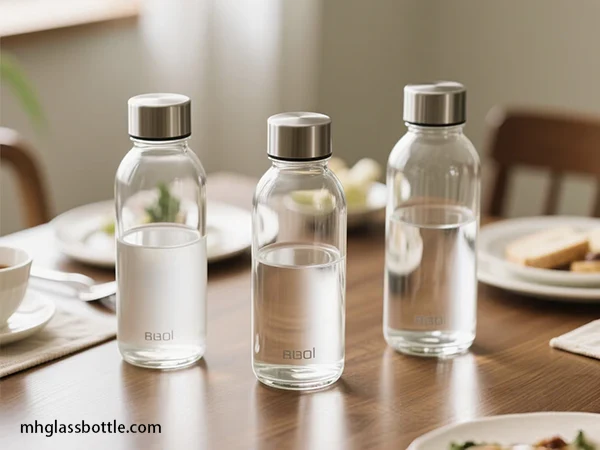
Tiny difference. Huge consequence.
Two millimeters matters.
I have been to glass factories where the buyers would enthusiastically ask for the "thickest bottle possible" and assume that the more glass the thicker the bottle, and therefore the higher the quality. Six months later, the same buyers griped about extremely high freight prices, reject rates, and poor performance at the filling line. The reality is this: there is no simple recipe for bottle strength with regards to wall thickness. A bottle's chances of reaching a supermarket shelf from the furnace depend chiefly on the quality of the glass chemistry, the precision of the mould, the quality of the annealing, the thickness distribution and surface defect. But why is the bottle weight still the primary factor in so many buying decisions?
The Short Answer
The recommended glass thickness for most soda lime glass water bottles of 500 ml capacity in the food grade is 2.2mm - 2.8mm. In commercial production, many glass bottle manufacturers aim for around 2.5 mm, as this is the point where durability, efficiency in production, shipping economy and product consistency are optimized for the product.
There are no universal thicknesses that will work for all applications, though. The best glass water bottle wall thickness will vary based on several factors such as the shape of the bottle, the design of the neck, the type of base, the intended filling method, how it is transported and whether it is designed for reuse or disposal. A well-designed bottle does not just make the average glass thickness more uniform, it distributes the glass around the bottle to give a uniform appearance.
| Bottle Type | Typical Wall Thickness | Typical Weight | Recommended Application |
| Lightweight | 1.8–2.2 mm | 200–260 g | Export, cost-sensitive products |
| Standard | 2.2–2.8 mm | 280–340 g | Water, juice, tea |
| Heavy Wall | 2.8–4.0 mm | 360–420 g | Premium beverages, decorative packaging |
| Carbonated | 3.0–5.0 mm | Varies | Internal pressure applications |
There Is No Universal Glass Water Bottle Wall Thickness Standard
There is a common misunderstanding among buyers that all glass bottles need to conform to a specific glass bottle wall thickness requirement that is set internationally. In fact, there is no such a global standard.
International standards don't prescribe a specific wall thickness but rather address product safety, food contact compliance, dimensional tolerances, product mechanical strength and quality control. When designing bottles, experienced manufacturers of glass bottles will take into account the performance requirements, not just looking for a single thickness.
For instance, the type of engineering required for a light-weight bottle for still drinking water is different from that for carbonated beverages, dairy or hot-fill applications. The wall thickness depends on various factors, including the internal pressure, filling temperature, distance of transport, and number of times it may be reused.
Consequently, professional manufacturing takes more account of:
- Even thickness of the wall
- Precise dimensional tolerances
- Stress relief by proper annealing
- Vertical load strength
- Impact resistance
- Thermal shock performance
Excellent bottle thickness consistency can produce a bottle that performs much better than a bottle that is simply made with thicker glass.
Why 2.5 mm Has Become an Industry Sweet Spot?
The preferred thickness of glass bottle wall is around 2.5 mm for many 500 ml glass bottles from an engineering and manufacturing point of view. This value is not a regulatory requirement, but rather has been optimized over many years of production.
Manufacturers can obtain several benefits at this size of about 2.5 mm:
- Very durable against daily use and handling/transit damage
- Reduced transport weight when compared with heavy wall bottles, this lowers transport costs
- Stable glass distribution in high speed IS machine manufacturing process
- Better dimensional uniformity for automated inspection systems
- Mechanical strength suitable for non-carbonated food and beverages
- Greater material efficiency and use
In fact, even a slight weight reduction of a bottle can result in substantial transportation savings for large volume beverage brands, without compromising product quality, as long as the bottle is designed properly.
Why Thinner Is Not Always Better?
Some buyers request extremely lightweight bottles to reduce production costs. While decreasing the glass water bottle wall thickness below 2.0 mm does reduce glass consumption and freight expenses, it also introduces several engineering challenges.
Thinner bottles become much more sensitive to:
- Local thin spots created during forming
- Surface scratches during production
- Impact damage during transportation
- Thermal shock caused by sudden temperature changes
- Increased rejection rates during quality inspection
To manufacture lightweight bottles successfully, factories require highly precise molding equipment, strict process control, advanced annealing systems, and continuous thickness monitoring. Without these capabilities, reducing wall thickness can actually increase production costs due to higher defect rates and product breakage.
Wall Thickness Does Not Equal Bottle Strength
This is where many procurement teams make expensive mistakes.
Glass strength depends on multiple interacting variables:
| Factor | Relative Influence |
| Wall thickness distribution | Very High |
| Annealing quality | Very High |
| Surface scratches | Very High |
| Mold accuracy | High |
| Glass composition | High |
| Bottle geometry | High |
| Average wall thickness | Moderate |
A uniformly distributed 2.4 mm wall often performs better than a bottle averaging 2.8 mm but containing localized thin sections. Engineers therefore evaluate bottles using thickness mapping, stress inspection, compression testing, and impact testing rather than relying on a single caliper measurement.
Lightweight Design Is Changing the Industry
Packaging has evolved from a mere cost-cutting measure to a lightweight packaging.
Manufacturers are increasingly decreasing the weight of the bottles to reduce CO₂ emissions, transportation expenses and raw material usage. Industry efforts focus on "right-weighting," a technique for eliminating unnecessary glass without compromising performance with better design, precision forming, and quality control. More recent packaging reports also indicate that the distribution of the glass weight is the more important factor as the average weight of the package becomes lower, as the local thin area becomes more significant.
FAQ
How thick should a water bottle (500ml glass) be?
Most commonly, a 500 ml glass food bottle will have a wall thickness somewhere around 2.2 mm to 2.8 mm, and 2.5 mm is the usual engineering target, because it sort of balances the competing needs—durability, manufacturing stability freight efficiency, and the cost of production for non-carbonated beverages. In practice you’ll see small variations, depending on weight, height, and how the bottle is made.
Does the thicker the bottle the stronger the bottle?
No. Although a thicker bottle is not necessarily stronger, it may be because other factors such as uniformity of thickness, residual stress, surface quality, bottle shape and annealing affect fracture resistance. A good quality thinner bottle is better than a poor quality heavier bottle.
What do you think is the required tolerance of wall thickness?
Different bottle designs have different tolerances around the world. The acceptable amount of variation is dependent on bottle shape, mold design and customer requirements, however, suppliers should include dimensional inspection data and thickness mapping in their quality assurance.
Call to Action
When ordering 500 ml glass water bottles wholesale, as a private label or OEM project, don't just ask for a bottle weight. Request wall-thickness distribution, annealing log, compression test analysis, and dimensional inspection from your supplier. Those documents tell you much more about long-term packaging performance than can any single thickness specification ever tell you.
 ONLINE