EN
EN AR
AR BG
BG HR
HR CS
CS DA
DA NL
NL FI
FI FR
FR DE
DE EL
EL HI
HI IT
IT JA
JA KO
KO NO
NO PL
PL PT
PT RO
RO RU
RU ES
ES SV
SV TL
TL IW
IW ID
ID LV
LV LT
LT SR
SR SK
SK SL
SL UK
UK VI
VI HU
HU TH
TH TR
TR FA
FA GA
GA LA
LA MI
MI MN
MN

How much does it actually cost to make custom glass bottles? For most commercial projects, there is no responsible way to answer that question with one number. A simple 250 ml sauce bottle made from an existing mold, a 500 ml frosted beverage bottle, and a 750 ml heavy-base spirits bottle with a privately owned mold may all come from soda-lime glass, yet their economics are completely different.
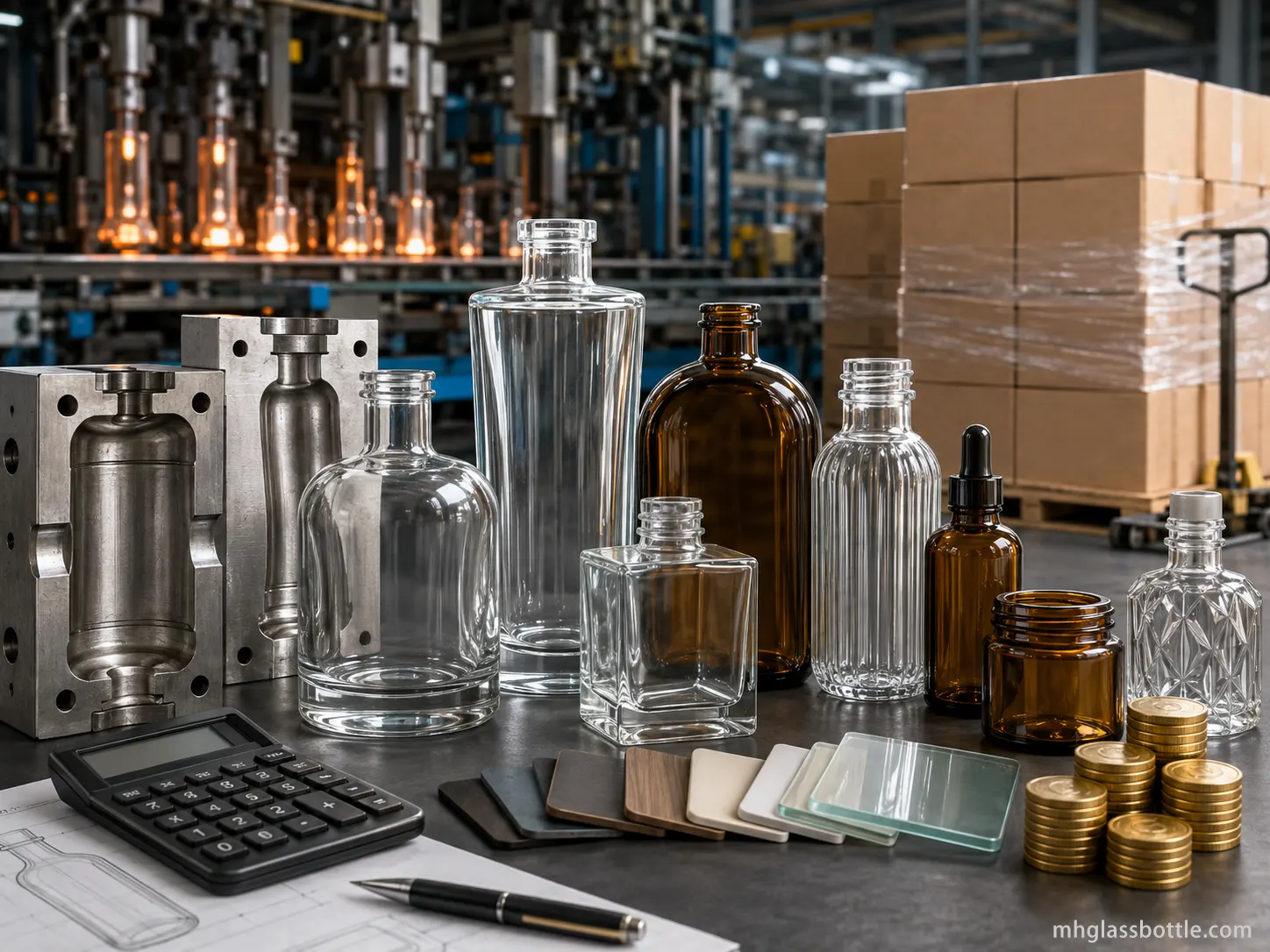
Costs hide everywhere.
When we calculate a real custom glass bottle cost, we do not look only at the factory's bottle price; we look at glass weight, mold development, forming efficiency, decoration, rejects, closures, export cartons, palletization, container utilization, freight, duties, testing requirements and, above all, how many acceptable bottles are produced from each manufacturing run.
So what are you really paying for?
A useful starting point is this:
Total landed bottle cost = bottle manufacturing + mold amortization + decoration + closure + packaging + QC/testing + inland logistics + ocean freight + import costs
That equation explains why comparing two quotations solely by the line marked “unit price” is often a purchasing mistake.
Public 2025 industry benchmarks illustrate the range. Ashland Container estimated standard 4–16 oz soda-lime bottles at medium volumes of 10,000–50,000 units at roughly $0.15–$0.40 per bottle, while its published examples put several additional decoration processes into the cents-per-piece range. These figures are useful as reference points, not universal factory prices, because bottle weight, geography, specification and manufacturing method change the result substantially. See the 2025 glass bottle manufacturing cost guide.
There is also good evidence that manufacturing will have a rolling cost base. According to the Producer Price Index for glass container manufacturing, primary products data from the U.S. Bureau of Labor Statistics (BLS) via FRED, the index for glass container manufacturing primary products increased from 283.328 in January 2024 to 298.425 in July 2025, a growth of approximately 5.3%. However, it is not to imply that all the bottle prices went up by 5.3%, it is to demonstrate why an old quotation can't be used as a supposed "permanent" price list. Look at BLS PPI for Glass containers data.
What is The Unit Cost of A Custom Glass Bottle?
The volume of bottles, their weight, type of glass color, neck, order, forming and decoration requirements should be known to the manufacturer before quoting a price per unit for custom glass bottles. The planning range for commercial soda-lime containers varies from far under $0.50, in the case of simple high-volume containers, to $1.00 or much greater, depending on the complexity and weight of the container and how much decoration it will require.
We would not evaluate a supplier using one advertised number.
Consider three bottles, each with a nominal capacity of 500 ml:
| Bottle Specification | Relative Cost Level | Why |
|---|---|---|
| Standard flint bottle, existing mold | Low | No new production mold; efficient forming |
| Existing bottle + one-color printing | Low–Medium | Adds decoration setup and printing |
| Private-mold embossed bottle | Medium | Tooling cost plus lower initial volume efficiency |
| Heavy-base premium bottle | Medium–High | More glass per unit and longer forming requirements |
| Frosted + coated + printed bottle | High | Multiple secondary processing stages |
| Complex irregular private-mold bottle | High | Tooling, forming difficulty and higher rejection risk |
Bottle weight matters more than many buyers expect. Glass is sold as a finished container, but the factory still has to buy, melt and form raw materials for every gram of glass entering production.
And melting is expensive.
The main batch chemistry of common container glass includes silica and soda ash, or sodium carbonate (Na₂CO₃), among other materials. The U.S. Geological Survey reported in its 2025 Mineral Commodity Summaries, using 2024 quarterly data, that glass accounted for approximately 45% of U.S. soda ash end use. That is one indication of how closely container manufacturing remains tied to commodity inputs. See the USGS Mineral Commodity Summaries 2025.
It is therefore not to expect that there is a manufacturing economy of 300 g and 700 g bottles, both of which contain 500ml of liquid.
What is the Price of a custom Glass Bottle Mold?
A glass bottle mold cost is a single tooling charge involving production when a buyer requires a unique bottle design (not a factory design) and will depend on the capacity, geometry, embossing, construction of the neck, cavity configuration, the sample needs, and the production equipment involved.
For budgeting, published industry examples frequently place custom bottle tooling in the low thousands of U.S. dollars, with more difficult projects moving higher.
One 2025 custom perfume bottle benchmark published mold costs of approximately $1,000–$8,000+, with fully customized projects generally requiring 10,000 units or more. That is a supplier-specific benchmark rather than a universal tariff, but it gives buyers a realistic order of magnitude. See the 2025 custom bottle mold and MOQ guide.
Here is where inexperienced buyers get confused: a “bottle mold” is not necessarily one simple piece of metal.
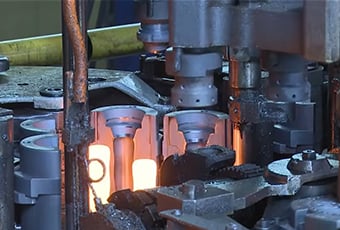
Industrial bottle forming can require a tooling system involving components such as:
- Blank molds
- Blow molds
- Neck rings
- Guide rings
- Bottom plates
- Baffles
- Blow heads
- Inserts for logos or embossing
- Sample or prototype tooling
A manufacturer also has to convert your concept into a manufacturable drawing. Sharp corners, dramatic undercuts, extremely thick bases, unusual shoulders or poorly specified neck finishes can all create problems that were invisible in the original rendering.
Pretty CAD files are cheap.
Production-ready geometry is not.
We therefore recommend asking whether the quoted glass bottle mold cost includes sample tooling, production tooling, revisions, logo inserts and ownership rights. Two factories can quote “$3,000 for the mold” while actually offering very different deliverables.
What happens to mold cost per bottle?
Assume a hypothetical private mold costs $3,000.
At 10,000 bottles:
$3,000 ÷ 10,000 = $0.30 per bottle
At 50,000 bottles:
$3,000 ÷ 50,000 = $0.06 per bottle
At 100,000 bottles:
$3,000 ÷ 100,000 = $0.03 per bottle
That is why the first order can look expensive while repeat production using the same approved tooling can have very different economics.
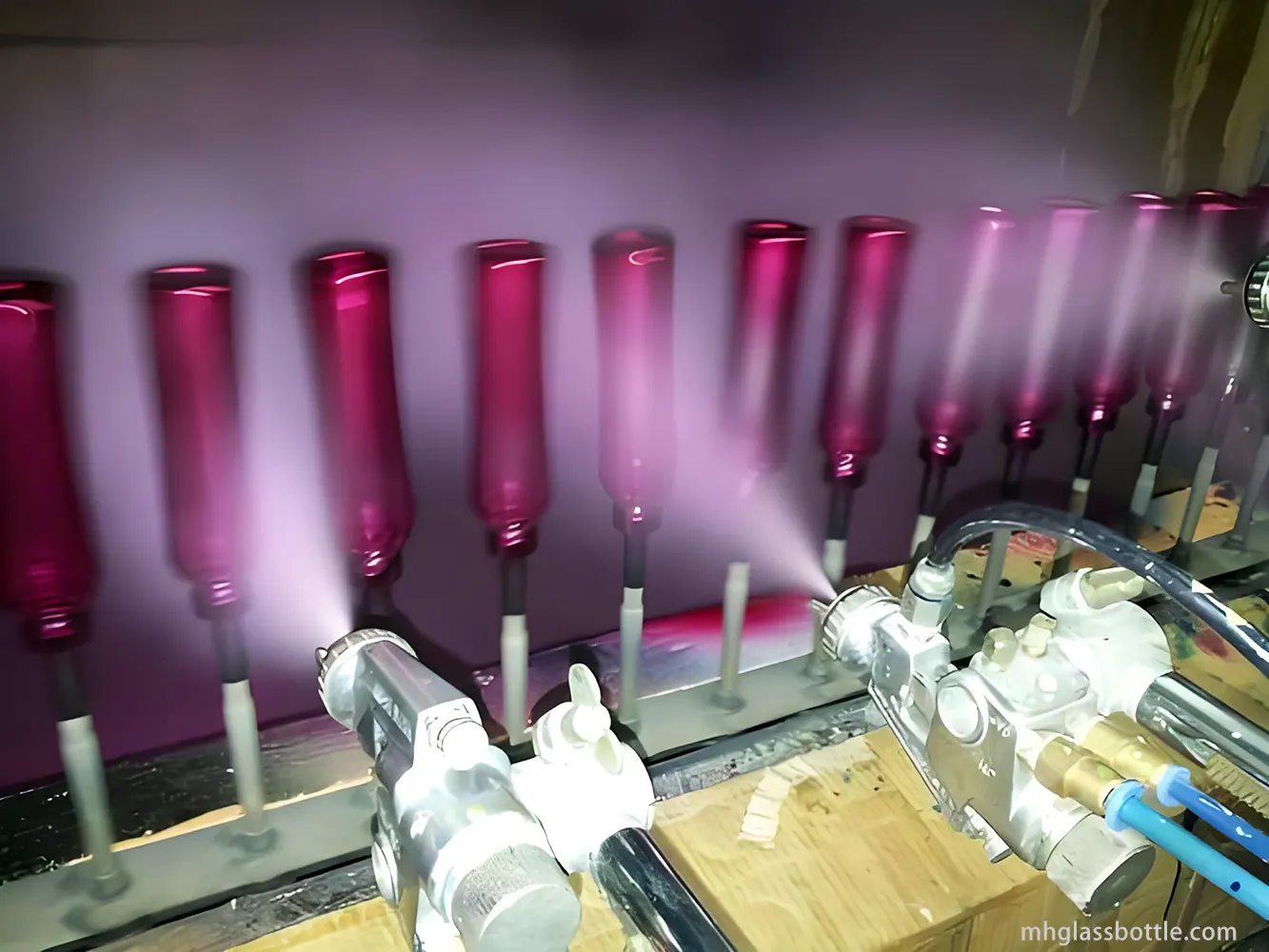
What Is the MOQ for Custom Glass Bottles?
A custom glass bottle MOQ is the minimum production quantity at which a factory can economically schedule the molds, forming machine, furnace output, color, inspection and secondary processing required for a particular bottle specification.
There are actually two MOQ conversations.
The first is a stock bottle MOQ.
The second is a private-mold manufacturing MOQ.
They are not equivalent.
A buyer may be able to purchase a relatively small quantity of an existing bottle and then customize it with printing, a label, coating or a unique closure. But once we open a private production mold and schedule a dedicated manufacturing run, the economics change.
As a broad commercial planning framework:
| Project Type | Typical Purchasing Logic |
|---|---|
| Stock bottle without decoration | Lowest entry quantity |
| Stock bottle + label | Low MOQ possible |
| Stock bottle + screen printing | Decoration MOQ applies |
| Stock bottle + coating/frosting | Processing MOQ applies |
| Private-mold bottle | Higher production commitment |
| Custom glass color | Usually substantially higher commitment |
| Complex private mold + multiple decorations | Highest commercial commitment |
A 2025 perfume-container benchmark published 500–3,000 units for decorating some stock bottles versus 10,000–30,000+ units for fully custom bottles. Those figures should be treated as one market reference rather than a rule for every factory or container category.
For B2B buyers, the better question is not:
“Who has the lowest MOQ?”
It is:
“What production route gives us the lowest total risk at our expected annual volume?”
A brand expecting to sell 4,000 bottles during its first year probably should not force a completely new structural bottle design just because a private mold sounds more professional.
Use stock intelligently.
Then customize where customers can actually see the difference.
What Factors Affect Custom Glass Bottle Pricing?
The biggest custom glass bottle pricing factors are not mysterious, but suppliers do a poor job of separating them in quotations.
We usually divide them into ten groups.
1. Bottle weight
More grams of glass generally mean higher material and melting requirements.
2. Capacity
Different molds and glass distribution/packing configurations are necessary for a 50 ml cosmetic bottle, a 330 ml beer bottle, a 500 ml juice bottle and a 1,000 ml spirits bottle.
3. Glass quality and color
Standard flint, high-flint, amber, green and specially colored glass are not interchangeable production specifications.
4. Shape complexity
Round bottles normally offer more forgiving forming conditions than highly angular, asymmetric or sculptural designs.
5. Neck finish
The neck must match the intended screw cap, lug cap, cork, pump, sprayer, dropper or other closure.
This deserves attention.
Saving $0.02 on the bottle means very little if the closure does not seal reliably on a customer's filling line.
6. Mold and tooling
New structural designs require development and tooling.
7. Decoration
Printing, decals, frosting, coating, electroplating, hot stamping and embossing all change cost.
8. Order quantity
Fixed setup expenses are distributed across more bottles at higher production volumes.
9. Packaging
Dividers, export cartons, trays, shrink wrapping and pallets add material and labor.
10. Logistics
Glass is dense, fragile and relatively heavy. Freight therefore deserves its own calculation rather than being buried inside “delivery.”
Which bottle type is more economical: Stock Bottle or Private Mold?
A stock glass bottle is typically a lower-cost option for low volume released as the buyer does not pay for new structural glass tooling and a, say, private mold option becomes more economically viable when repeat volume, brand distinction or proprietary geometry is warranted by the initial investment.
Typically, we are asked to make the decision in this way:
| Factor | Stock Bottle | Private Mold |
|---|---|---|
| Initial investment | Lower | Higher |
| Mold fee | Usually none | Required |
| MOQ | Usually lower | Usually higher |
| Launch speed | Faster | Slower |
| Structural uniqueness | Limited | High |
| Logo decoration | Yes | Yes |
| Embossed structural branding | Limited | Excellent |
| Engineering work | Low | Higher |
| Best for market testing | Yes | Usually no |
| Best for proprietary packaging | Limited | Yes |
| Repeat-order economics | Good | Can improve strongly at scale |
What many startups actually need is neither a completely generic bottle nor a completely private bottle.
The middle ground is often better:
existing bottle + custom closure + custom color treatment + branded printing + differentiated secondary packaging.
That combination can create a distinctive retail presentation without forcing the buyer to finance a structural mold during the validation stage.
How Does Order Quantity Affect Glass Bottle Unit Cost?
Order quantity changes glass bottle unit cost because tooling, setup, machine changeover, decoration preparation, QC administration and other fixed expenses can be distributed across a larger number of sellable containers.
The basic procurement equation is:
Effective Unit Cost = Bottle Price + (Tooling ÷ Quantity) + (Setup Charges ÷ Quantity) + Decoration + Packing + Freight per Unit
This is why wholesale glass bottle pricing often operates in tiers.
But buying more is not automatically cheaper.
If your annual demand is 20,000 bottles and you order 100,000 simply to save $0.08 per bottle, you have exchanged an $8,000 theoretical purchasing saving for warehouse costs, trapped cash and four years of inventory.
That is not procurement efficiency.
It is overbuying.
Buyers should therefore compare:
purchase price + storage + working capital + obsolescence risk + breakage risk
rather than chasing the lowest factory unit price.
How Much Do Printing, Frosting, Coating and Logo Customization Cost?
Decoration can add anything from a few cents to several tenths of a dollar per bottle, and sometimes considerably more, depending on the process, number of colors, coverage area, curing requirements, order quantity, registration tolerances and whether multiple decoration processes are combined.
Typical options include:
| Customization | Cost Impact | Main Cost Driver |
|---|---|---|
| Paper / pressure-sensitive label | Low | Label material + application |
| Single-color screen printing | Low | Screen + ink + setup |
| Multi-color printing | Low–Medium | Multiple passes and registration |
| Decal | Medium | Artwork + transfer + firing |
| Frosting | Medium | Surface treatment |
| Spray coating | Medium | Coverage, paint and curing |
| Hot stamping | Medium–High | Foil + setup + registration |
| Embossed logo | Tooling-led | Mold insert / structural tooling |
| Electroplating / specialty finish | High | Multiple processing stages |
Published 2025 examples from Ashland Container put spray coating at approximately $0.15–$0.35 per unit and hot stamping at around $0.20–$0.45 per unit for its reference projects. Again, these are examples, not universal market prices.
And decoration can interact with bottle geometry.
A flat printing area is easier.
A heavily curved shoulder is not.
A technically possible logo may therefore become an economically stupid logo if it creates slow printing, poor registration and excessive rejects.
We would rather change the artwork before production than explain thousands of defective bottles afterwards.
What is the cost of shipping to complete the Cost of the Glass Bottle?
Shipping cost per bottle is the total of the origin, ocean, destination and import logistics cost, and is mathematically determined by dividing by the number of acceptable bottles loaded, where the bottle size, carton design, palletization, container utilization, destination port, and freight market conditions can be a concern of almost equal magnitude to the quoted ocean freight itself.
In 2024, it would no longer be possible to overlook it.
According to UN Trade and Development, severe shipping disruptions spooked up container rates in July 2024 to around $3,600, a 149% rise from 2023, while their average level last year was 2,496 points. See UNCTAD's 2025 maritime trade analysis.
UNCTAD was also earlier reporting an average 256% jump in the spot rate between Shanghai and Europe between early December 2023 and early February 2024.
The reason why we do not want to permanently publish one shipping cost per bottle is this volatility.
Instead, use an equation.
Assume the ocean shipping charge is $4000 and export packages and bottles that can be shipped in a container is 25,000.Consider that the ocean freight cost be $4000, while you are contemplating on utilizing the shipping container of 25,000 units for the import and packing with the bottles that you chose.
$4,000 ÷ 25,000 = $0.16 ocean freight per bottle
But that $0.16 is not necessarily the landed logistics cost.
You may still have:
- Factory-to-port transport
- Export documentation
- Terminal charges
- Customs clearance
- Import duty
- Port fees
- Destination trucking
- Pallet handling
- Cargo insurance
- Warehousing
And bottle design affects this calculation.
A wide decorative bottle may look excellent on a shelf while using container space terribly.
A slightly smaller bottle can make some more sense for logistics than they can make as a supplier remove from the price of the glass bottle.
Example: Cost Breakdown for 10,000 / 50,000 / 100,000 Custom Bottles
Easier to see the economics is an illustrative budgeting model rather than a supplier quotation.
Assume:
- Standard soda-lime glass
- Roughly 300–500 ml capacity
- Flint glass
- Relatively straightforward geometry
- Private mold
- Hypothetical mold investment: $3,000
- One moderate decoration process
- Closure excluded
- International freight excluded
Public 2025 pricing examples put standard bottle pricing around $0.35–$0.60 at 10,000–25,000 units and $0.25–$0.45 at 50,000–100,000 units for the referenced products.
Using those figures only as a planning model:
| Cost Item | 10,000 Bottles | 50,000 Bottles | 100,000 Bottles |
|---|---|---|---|
| Example base bottle | $0.35–$0.60 | $0.25–$0.45 | $0.25–$0.45 |
| $3,000 mold amortization | $0.30 | $0.06 | $0.03 |
| Example decoration allowance | $0.08–$0.25 | $0.08–$0.25 | $0.08–$0.25 |
| Indicative subtotal per bottle | $0.73–$1.15 | $0.39–$0.76 | $0.36–$0.73 |
| Mold investment | $3,000 | $3,000 | $3,000 |
| Freight | Quoted separately | Quoted separately | Quoted separately |
The important number here is not $0.73 or $0.39.
It is the mold amortization.
Our fictional $3,000 tooling cost is then applied to each first order bottle, or 10,000 bottles in this case.
At 100,000 bottles, it adds only $0.03.
On a repeat production run using approved existing tooling, that original development cost no longer needs to be treated as a new $3,000 cash expense.
This is why a new-product launch and an established repeat-order program should never be evaluated with the same purchasing logic.
How to Get an Accurate Quote From a Glass Bottle Manufacturer
An accurate quotation from a custom glass bottle manufacturer requires enough engineering and commercial information to calculate the bottle, tooling, decoration, packaging and delivery separately; sending only a reference photograph and asking “how much?” usually produces either a very broad estimate or a deceptively cheap number based on assumptions.
We recommend providing at least:
- Bottle capacity: 100 ml, 250 ml, 500 ml, 750 ml, etc.
- Target dimensions: height and maximum diameter.
- Target bottle weight, if known.
- Reference image, sketch, STEP file or technical drawing.
- Glass color: flint, amber, green or custom.
- Neck finish and closure type.
- Required order quantity.
- Expected annual volume.
- Decoration: printing, frosting, coating, embossing, label, hot stamping, etc.
- Required packaging method.
- Testing or compliance requirements.
- Delivery country and destination port.
- Target delivery date.
Annual volume is especially useful.
We suggest you consider a different solution if you have a need for 20,000 bottles today and 300,000 bottles per year, compared with a project that requires 20,000 bottles and doesn't ever place another order.
And ask suppliers to separate the quote.
At minimum, we want to see:
Bottle + Mold + Decoration + Closure + Export Packing + Freight
A single “FOB unit price” can be convenient, but it also makes it harder to understand where the money is actually going.
What Is Really Driving Glass Manufacturing Cost?
Energy deserves more attention than it normally receives in packaging articles.
Glass furnaces operate at high temperatures, and the industry's efforts to reduce fossil-fuel dependence demonstrate how significant melting energy remains. In December 2024, the U.S. Department of Energy announced more than $2.7 million in initial funding, from a potential federal cost share of up to $75 million, for Gallo Glass Company's Hybrid Electric Glass Furnace Project. The project targets up to a 70% reduction in natural-gas use and more than a 40% reduction in cradle-to-gate carbon intensity compared with conventional gas-powered furnaces. See the U.S. Department of Energy project announcement.
Why should a bottle buyer care?
Because raw materials and energy are not abstract factory expenses. They eventually appear somewhere in the quotation.
The same applies to forming efficiency.
A bottle design that generates more rejects effectively requires the factory to spend material, machine time, heat, inspection labor and handling capacity on products nobody can sell.
That risk gets priced.
Maybe visibly.
Maybe not.

FAQ
Are Custom Glass Bottles More Expensive Than Stock Bottles?
Custom glass bottles are generally more expensive at the beginning of a project because a proprietary shape can require engineering, sampling, production molds and a dedicated manufacturing run, whereas a stock bottle spreads its existing tooling investment across many buyers and can therefore be purchased at lower quantities with less upfront development expense.
The difference becomes less severe as production volume increases because the original tooling cost is amortized over more bottles. A private mold can therefore make commercial sense for a mature product even when it makes little financial sense for an early test launch.
Can I Order Only 1,000 Custom Glass Bottles?
An order of 1,000 bottles is often feasible when customization means applying labels, printing or selected decoration to an existing stock container, but it is usually much harder to justify when “custom” means developing a completely new bottle structure, private mold and dedicated industrial forming run specifically for those 1,000 pieces.
For low-volume projects, we normally recommend separating structural customization from visual customization. Existing glass plus a custom closure, label, color treatment or printing can reduce capital exposure dramatically.
Do I Have to Pay the Glass Bottle Mold Fee on Every Order?
A glass bottle mold fee is normally associated with developing the tooling for a new proprietary design rather than being charged as a completely new development cost on every repeat order, although mold ownership, maintenance, replacement terms, storage and modification rights should always be confirmed contractually with the manufacturer before production begins.
Ask this before paying.
Check to see who owns the mold (you, factory, or used only by you).
Which is the most cost-effective method of decorating glass bottles?
The cheapest method to decrease the custom glass bottle costs is typically to choose a factory bottle form, stick to the typical glass color and neck finish, and start making the bottle itself unique by adding a label, screen printed logo, closure, sleeve or secondary packaging.
This way you won't have to pay one of the biggest initial fixed costs and you may even obtain a lower MOQ.
Once sales volume becomes predictable, migrating to a private mold becomes easier to justify.
How Can I Reduce Custom Glass Bottle Price Per Unit?
A buyer can reduce custom glass bottle price per unit by increasing economically justified order volume, reducing unnecessary glass weight, simplifying difficult geometry, limiting decoration processes, using standard neck finishes, improving carton and container utilization, consolidating SKUs and negotiating repeat-production terms rather than focusing exclusively on the supplier's headline bottle price.
Do not remove specifications that protect the product just to chase cents.
The objective is not the cheapest bottle.
The objective is the lowest commercially acceptable landed cost.
Get a Real Custom Glass Bottle Cost, Not a Guess
If you are planning a new food, beverage, spirits, cosmetic or other glass packaging project, send us your capacity, quantity, bottle drawing or reference image, neck finish, decoration requirements, closure and destination port.
We can compare two routes:
Option A: Existing bottle + custom decoration
and
Option B: Private mold + fully custom glass bottle
That comparison usually tells you far more than asking for the cheapest bottle price.
Because in custom glass packaging, the cheapest quotation and the lowest total cost are not always the same thing.
 ONLINE